8 CE-Oriented High Voltage Transformer Products for Project Shortlisting
The search intent behind “CE certified high voltage transformer suppliers & exporters” is usually a shortlist task: buyers need a traceable product path, not a generic catalogue page. The eight products below preserve the original product URLs and cover oil-immersed distribution, ANSI pole-mounted, dry-type, step-up, pad-mounted and S11 distribution applications. Use them as a starting point for technical comparison.
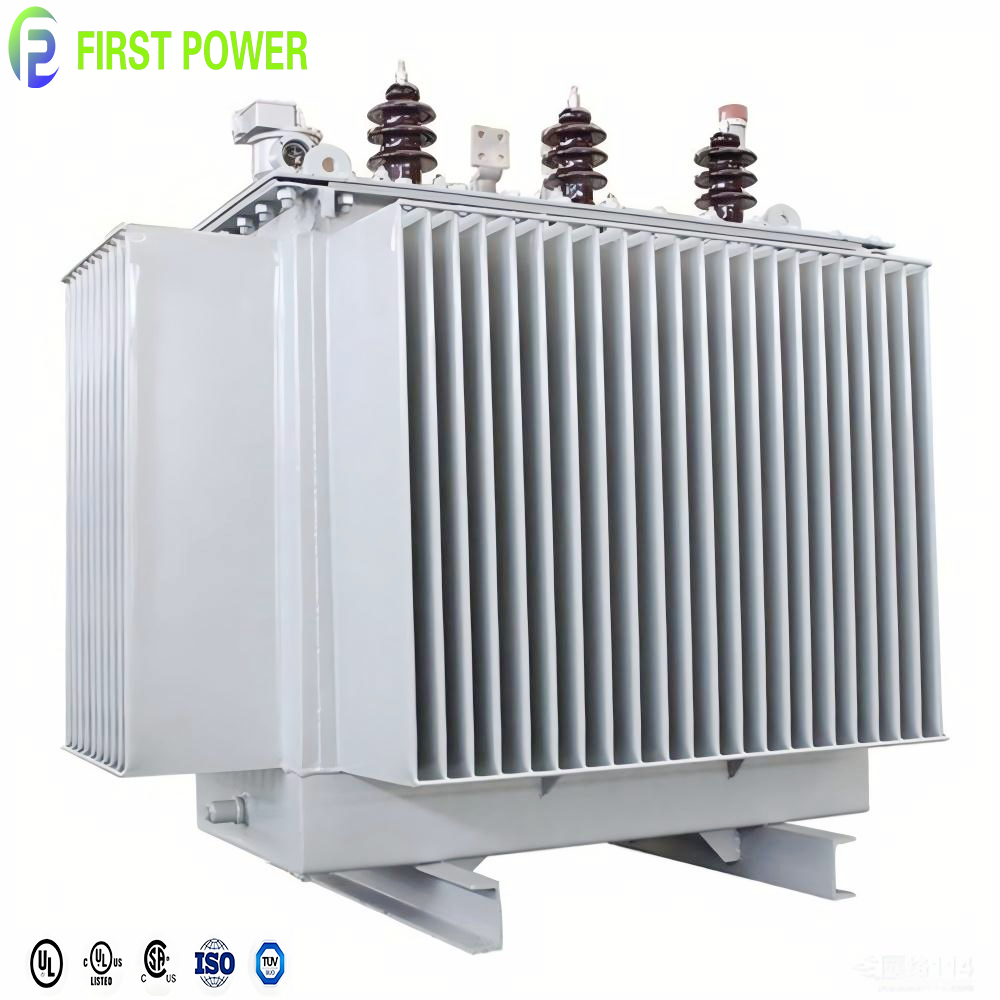
C CE MH&HV 50/60HZ 10KVA-50000KVA 10KV 15KV 20KV 35KV Three Phase S11 Oil Transformer for Electric Power Distribution
A broad three-phase oil-immersed distribution platform for utility feeders, industrial plants and renewable collector substations where low losses and proven S11 magnetic design are valued.
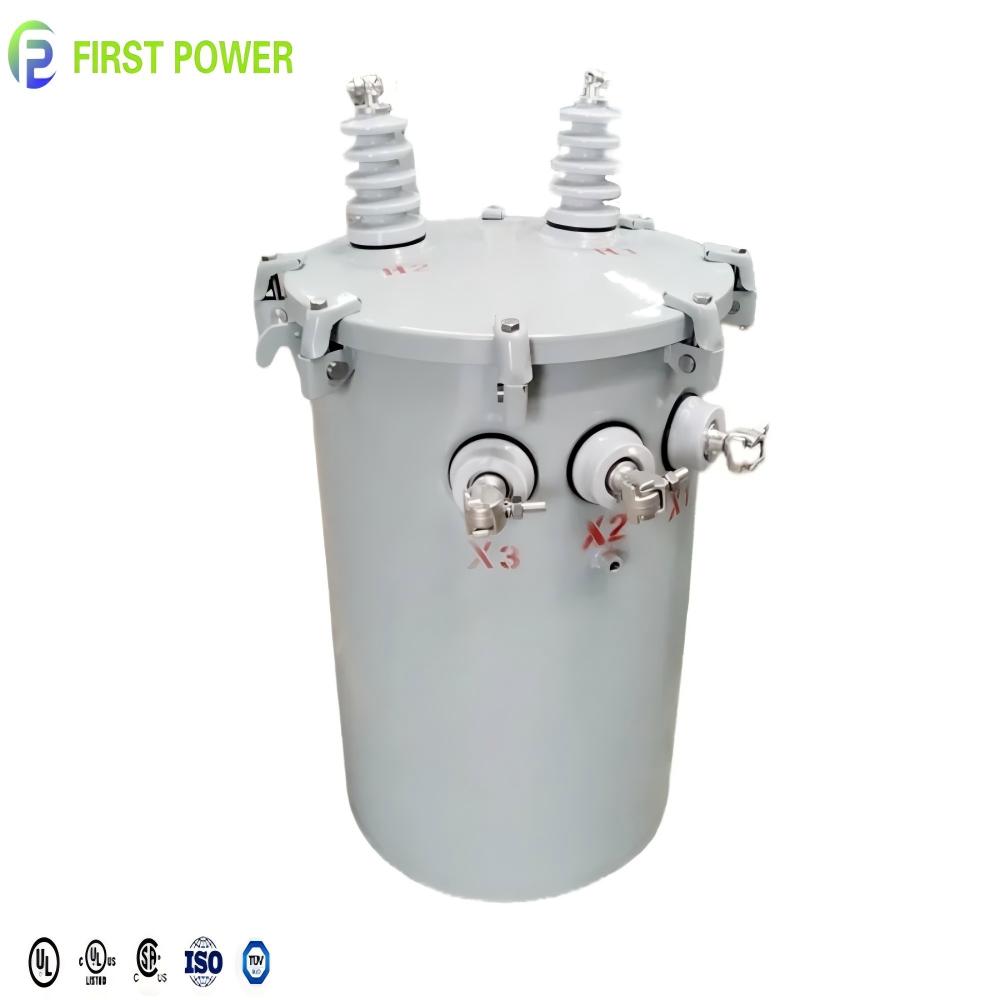
ANSI 50/60HZ 6KV 10KV 15KV 20KV 35KV 15KVA 25KVA 50KVA 100KVA Single Phase Pole Mounted Transformers for Industrial Power Supply
A practical ANSI-style path for residential subdivisions, rural feeders and light industrial loads where single-phase pole-mounted equipment and local utility practice are decisive.
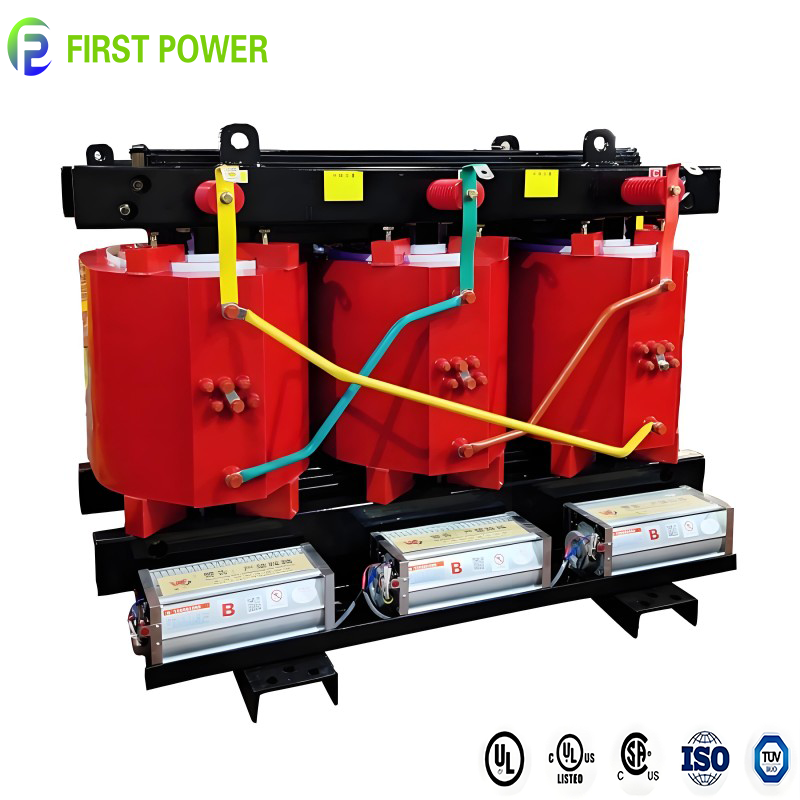
C CE Certification IEEE Standard 50/60HZ 5MVA 6MVA 6KV 35KV 3 Phase Dry Type Transformer for Electric Power Distribution
A dry-type option for indoor, fire-sensitive or oil-free environments such as hospitals, commercial buildings, tunnels, data centres and urban distribution rooms.
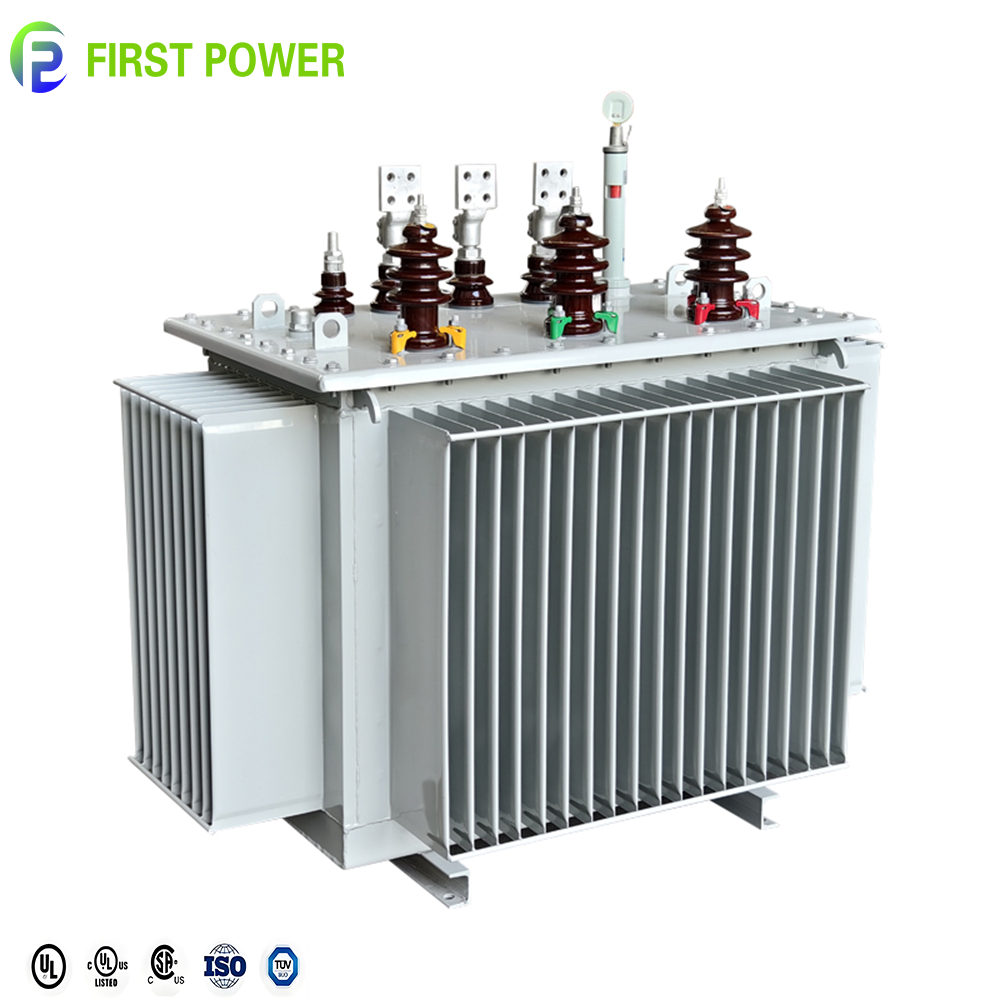
C CE 50/60HZ 6KV 10KV 15KV 20KV 35KV 100KVA 200KVA 300KVA 500KVA 220V Output Voltage Step up Oil Transformer for Industrial
A step-up oil transformer path for industrial processes, generator interfaces and projects needing 220 V output arrangements with medium-voltage primary design.
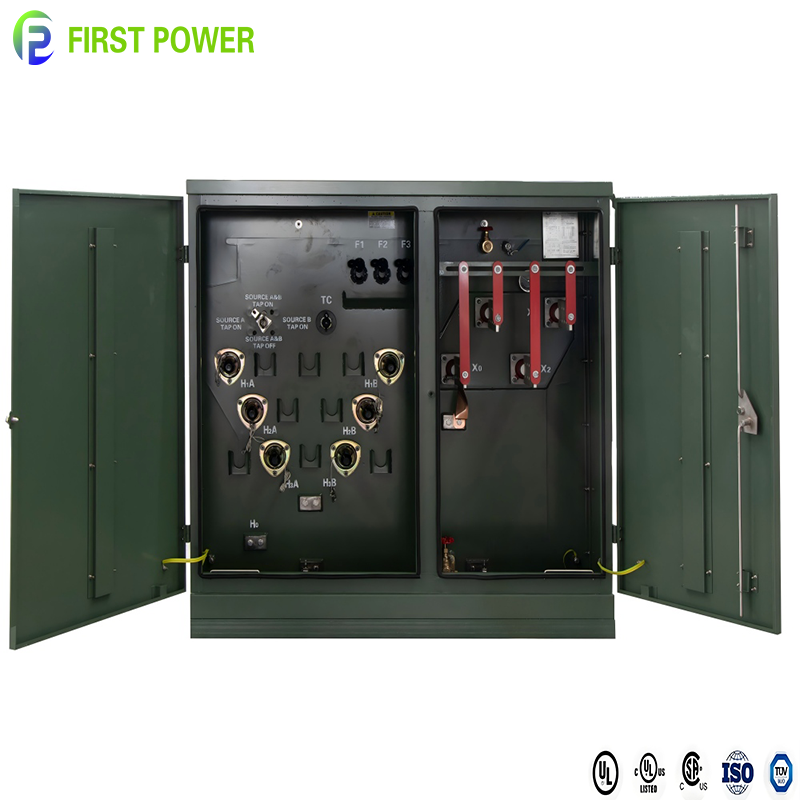
Listed C CE MV&HV 50/60HZ 6KV 10KV 15KV 20KV 35KV 3 Phase Pad Mounted Transformer Electrical for Industrial Power Supply
A compact pad-mounted solution for industrial power supply, commercial campuses and underground distribution where enclosure security and site footprint matter.
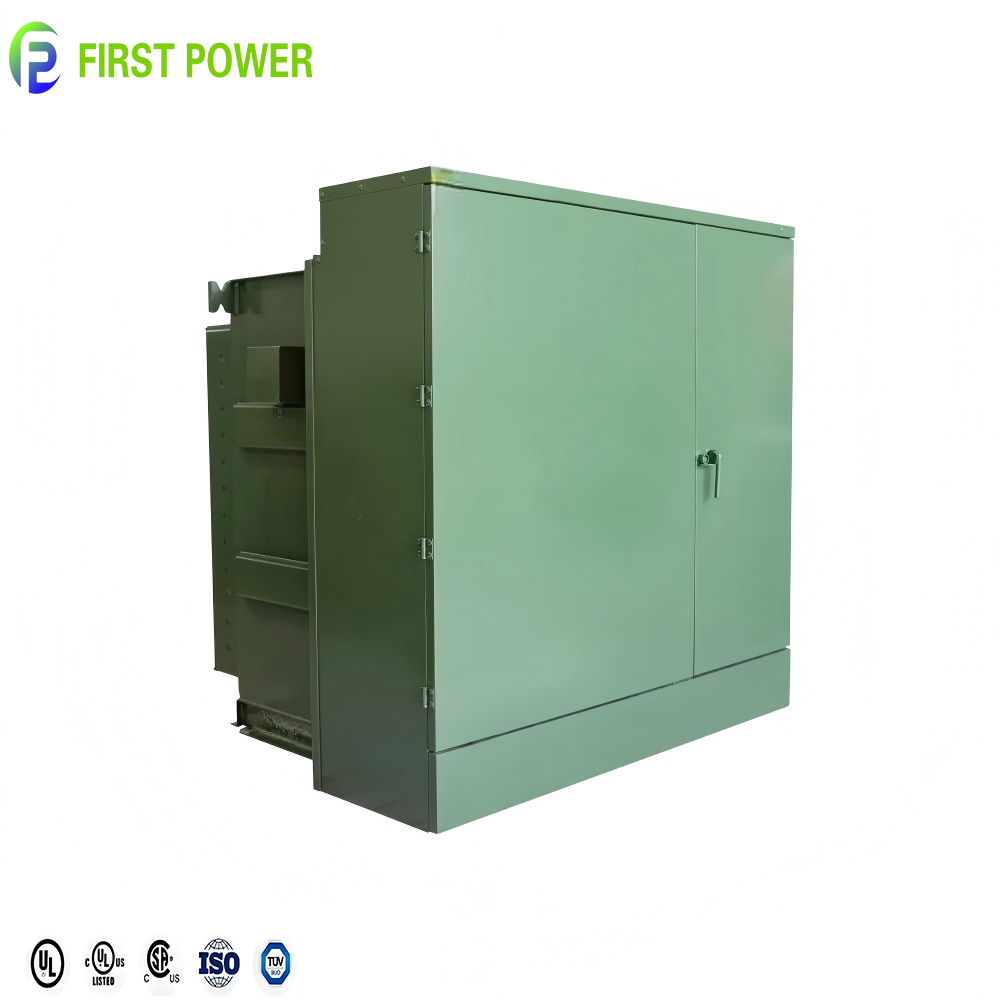
C CE MV&HV 50/60HZ 750KVA 1250KVA 1500KVA 2000KVA 2500KVA 3 Phase Pad Mounted Transformer for Industrial Power Supply
A higher-capacity pad-mounted transformer path for data centres, manufacturing plants, commercial developments and utility projects with concentrated loads.
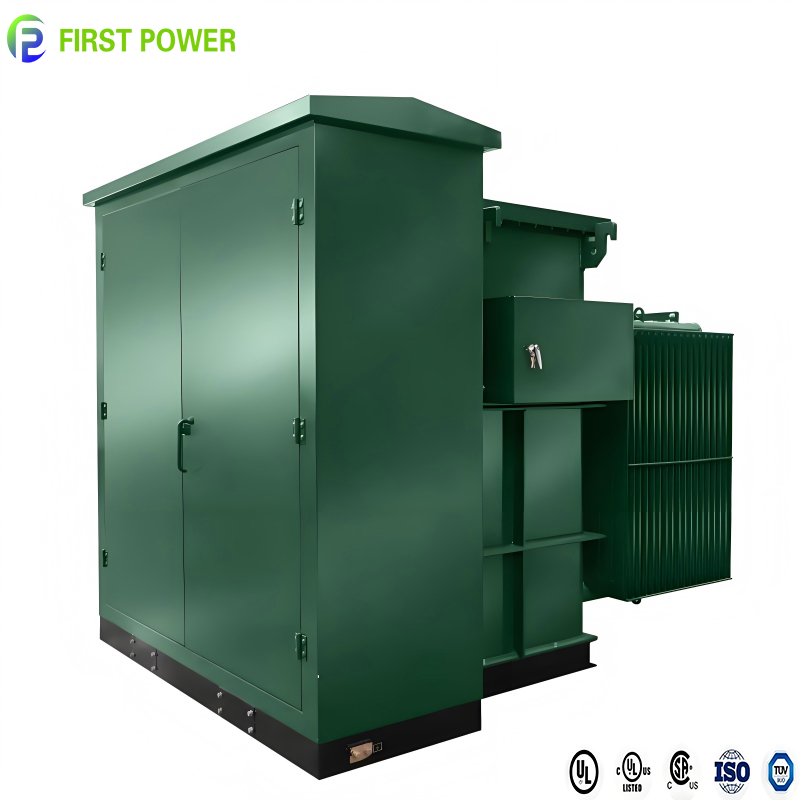
C CE 50/60HZ 6KV 10KV 15KV 20KV 35KV 100KVA 300KVA 500KVA 630KVA 3 Phase Pad Mounted Pedestal Transformer for Industrial
A pad-mounted pedestal path for distribution projects requiring an accessible, tamper-resistant footprint in commercial, institutional or industrial environments.
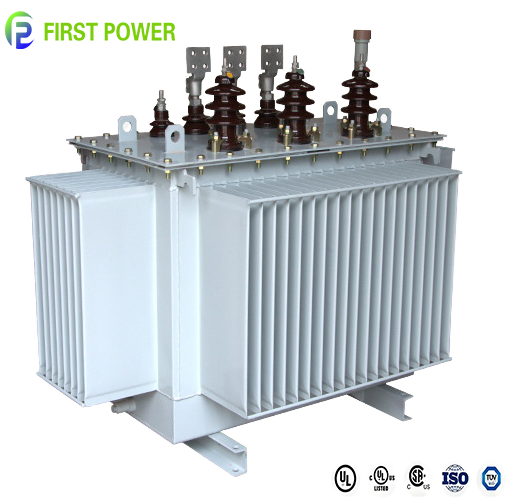
C CE 50/60HZ S11 10KV 15KV 20KV 35KV 100KVA 300KVA 500KVA 630KVA Three Phase Oil Transformer Price for Distribution System
A focused S11 distribution transformer path for buyers comparing initial price, guaranteed losses, routine test evidence and lifecycle cost in utility distribution networks.
Selection logic: use the S11 oil transformers for utility distribution and industrial distribution; the ANSI pole-mounted path for North American-style residential feeders; dry-type for indoor fire-sensitive sites; pad-mounted units for space-constrained commercial or industrial projects; and step-up oil transformers for generator or process interfaces. Confirm every model against your project’s voltage, frequency, altitude, ambient, vector group, impedance and local grid-code requirements before tender award.
Why Supplier Evidence Matters More Than a Product Photo
A transformer quotation can look similar across suppliers while the underlying evidence chain varies heavily. These figures reflect the manufacturer profile described by Jiangsu Wisegj Power Co., Ltd. and should be verified against your project documents.
Years of team experience in transformer engineering and export projects
Maximum voltage class position described for the product portfolio
Verified production floorspace reported through third-party assessment
R&D and technical engineers supporting design and application review
Qualified supply-chain partners supporting material and component stability
Average buyer rating presented in the original company profile
What “CE Certified” Should Mean When You Buy High Voltage Transformers
The search phrase “CE certified high voltage transformer suppliers & exporters” is not just a product query. It is a due-diligence query, a standards query and a supply-chain query. A serious buyer wants to know which model is covered, which directive and standards apply, which factory tests are routine, which documents travel with the shipment and which supplier remains accountable after commissioning.
High-voltage transformer procurement is a long-term capital decision. A 10 kV, 35 kV or 500 kV unit may be purchased once, but its losses, outage risk, documentation, spare-parts support and compliance record affect the owner for decades. That is why a CE logo alone is not a supplier qualification. The buyer needs a traceable chain from design calculation to routine test to sea-worthy packing and after-sales response.
The strongest suppliers make that chain easy to audit. They provide certificate numbers, model-linked scope, guaranteed losses, routine test reports, general arrangement drawings, nameplate drafts and clear Incoterms. They welcome witness testing, answer technical questions with an engineer rather than a sales script, and explain how their product will comply with local frequency, voltage, altitude and ambient requirements.
Regulatory Scope
Confirm the directive, standard, certificate scope, issuing body and validity period. A certificate for a different rating or enclosure does not automatically qualify the offered unit.
Technical Design
Check losses, impedance, vector group, tap range, cooling, insulation level, altitude, ambient temperature, seismic requirement and local grid-code practice.
Factory Evidence
Request routine test reports by serial number, oil dielectric reports for liquid-filled units, calibration records and, where specified, third-party witness inspection.
Lifecycle Documentation
Require GA drawings, nameplate approval, O&M manuals, packing list, warranty terms, spare-parts list and a named technical response channel.
| Evidence requested | What it proves | Red flag to avoid |
|---|---|---|
| CE certificate with model/range and directive | Shows whether the offered product is inside the claimed certification scope | A generic certificate that does not link to the product family, rating or manufacturing site |
| Routine test report with serial number and date | Demonstrates factory verification of ratio, resistance, losses, impedance and dielectric performance | Unsigned report, missing serial number or results copied from a different project |
| Type test or design evidence where applicable | Supports the design basis for short-circuit, temperature-rise or dielectric performance | Type test certificate for an unrelated model or an expired standard |
| ISO 9001, ISO 14001 and ISO 45001 certificates | Indicates management-system control over quality, environment and safety processes | Expired certificate or certificate number that cannot be verified |
| Guaranteed losses, impedance and tap range in the contract | Converts catalogue claims into measurable lifecycle-cost commitments | “Typical” data only, with no guaranteed values or penalty mechanism |
| Packing method, impact recorder and shipping documents | Reduces risk of hidden transport damage and customs delay | No export packing specification, no loading photos and no shock indication |
A strong procurement file should let your compliance team, engineering team and site team answer three questions independently: Is the model covered? Was it tested? Can we install and maintain it confidently?
The Future of High Voltage Transformer Procurement: Six Shifts Buyers Should Price In
The next procurement cycle will reward buyers who move from “lowest first cost” to “lowest evaluated lifecycle risk”. For CE certified high voltage transformer exporters, the ability to provide technical evidence, local-code adaptation and delivery transparency will matter as much as the factory price.
Loss Capitalization and TCO
Buyers increasingly evaluate no-load and load losses against the project load profile. A higher capex offer can be justified when guaranteed loss savings and efficiency commitments are written into the contract.
Digital Compliance Dossiers
Procurement teams want one structured package: certificate scope, GA drawing, nameplate approval, routine test report, material traceability, packing list and warranty. Fragmented PDFs slow approval.
Supply-Chain Resilience
Dual sourcing is moving beyond price comparison. Buyers now ask which bushings, tap changers, core steel and insulation materials are used, and how lead times are protected when one component is constrained.
Sustainability and Fluids
Ester-fluid transformers, leakage containment, recyclability, noise limits and material declarations are entering tenders for urban, renewable and environmentally sensitive projects.
Prefabricated Substations
Factory-assembled compact substations reduce site labour, interface risk and commissioning time. Procurement teams are buying more integrated modules rather than isolated transformers.
Local Grid-Code Engineering
50/60 Hz, 10 kV, 35 kV, 500 kV, altitude, ambient, seismic and utility practice must be designed into the unit. A compliant transformer is not created by relabelling a standard stock model.
Illustrative evaluation weighting for tender design, not a market forecast or a universal scoring model. Each project should define its own weightings based on criticality, load profile, climate and local regulation.
Product Development Trends in CE Certified High Voltage Transformers
Transformer design is evolving around efficiency, safety, grid integration and documentation quality. Buyers should understand these trends because they affect specification decisions, spare-parts strategy and total cost of ownership.
Low-Loss Cores and Efficiency
CRGO and amorphous core options continue to attract attention where loss capitalization is high. The key is to guarantee no-load and load losses at the project reference temperature, not just advertise “low loss”.
Dry-Type for Fire-Sensitive Sites
Oil-free cast-resin transformers are increasingly specified for hospitals, tunnels, high-rise buildings and indoor distribution rooms where fire load and leakage risk must be minimized.
Monitoring-Ready Designs
Temperature, moisture and partial-discharge monitoring options are becoming easier to integrate. For critical sites, specify sensor interfaces and data protocols before the enclosure is finalized.
Pad-Mounted Modularity
Dead-front, loop-feed and compact enclosure designs continue to improve safety and reduce site footprint. Modular configurations help utilities standardize while allowing project-specific cable and protection arrangements.
Renewables-Ready Substations
Solar, wind and storage projects need fast interconnection and coordinated protection. Prefabricated compact substations combine MV switchgear, transformer and LV distribution in one tested enclosure.
Circular Design and Service Life
Recyclable metals, controlled insulating fluids, replaceable accessories and clear maintenance documentation support longer service life and better end-of-life planning for asset owners.
Why Jiangsu Wisegj Power Co., Ltd. Is a Credible CE Certified Transformer Exporter
Jiangsu Wisegj Power Co., Ltd. is a Suzhou-based manufacturer and exporter of power transformers, distribution transformers, pad-mounted transformers, dry-type transformers, compact substations, switchgear and related electrical equipment from 220 V to 500 kV. The company combines export documentation discipline with an engineering-led quotation process.
Experience: the team brings more than 20 years of hands-on transformer experience, covering utility distribution, industrial power supply, renewable projects and export contracts. This experience is most valuable at the front end of a project, when voltage class, frequency, vector group, impedance, altitude and ambient conditions are still being finalized.
Expertise: the company reports 50+ R&D and technical engineers and provides OEM, ODM, design-based and sample-based customization. Product documentation can include GA drawings, nameplate drafts, routine test reports and English O&M manuals, which reduces clarification cycles between owner, EPC and QA teams.
Authority: production capability, floorspace and quality inspection have been verified onsite by TÜV Rheinland, an independent third-party inspection body. The company reports 6,847 m² of verified production floorspace, 211 qualified supply-chain partners and experience serving Fortune 500 buyers. Management systems include ISO 9001, ISO 14001 and ISO 45001.
Trust: CE certificates are referenced for oil-immersed power transformers, dry-type transformers and compact substations. Certificate numbers should always be checked against the exact offered model and project scope. Wisegj also emphasizes 24-hour pre-sale and after-sale response, finished-product inspection and export packing controls.

Evidence to request from any supplier
- CE certificate number, scope and validity
- Model-linked routine test report
- ISO 9001 / 14001 / 45001 certificates
- GA drawing and nameplate approval
- Warranty, spare-parts list and response channel

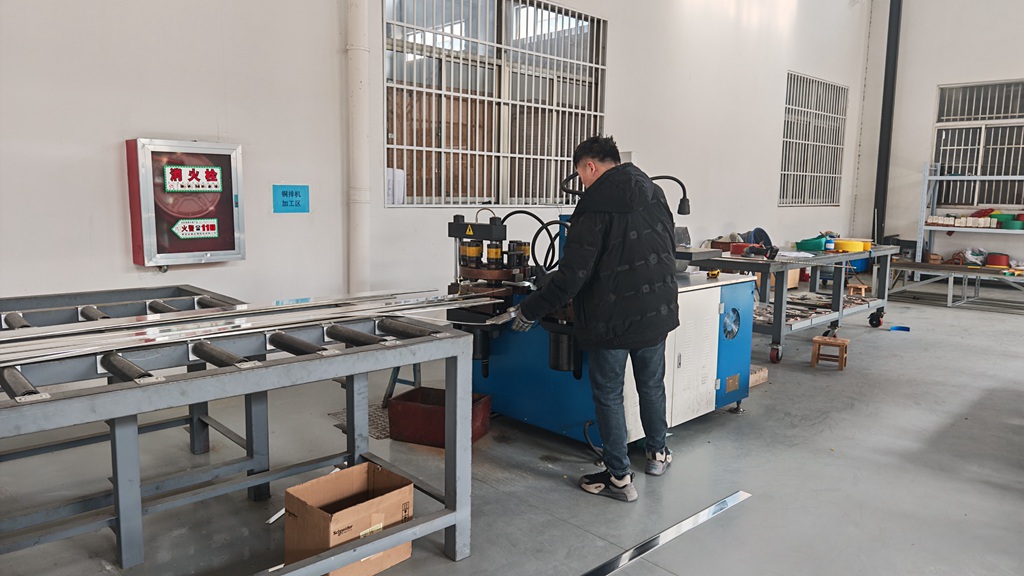
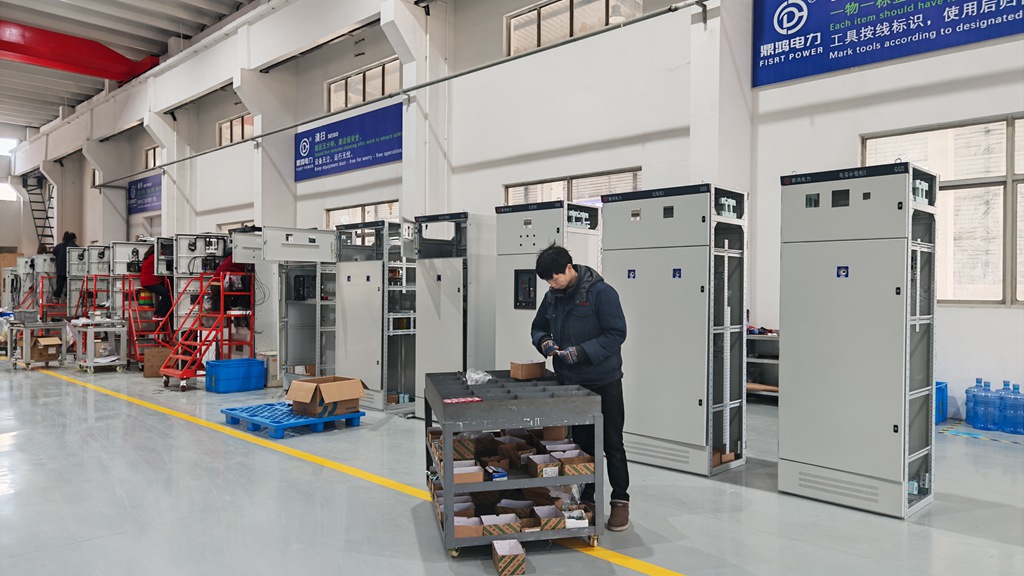
Company & facility overview

Assembly workshop
Testing laboratory
Export packing & loading
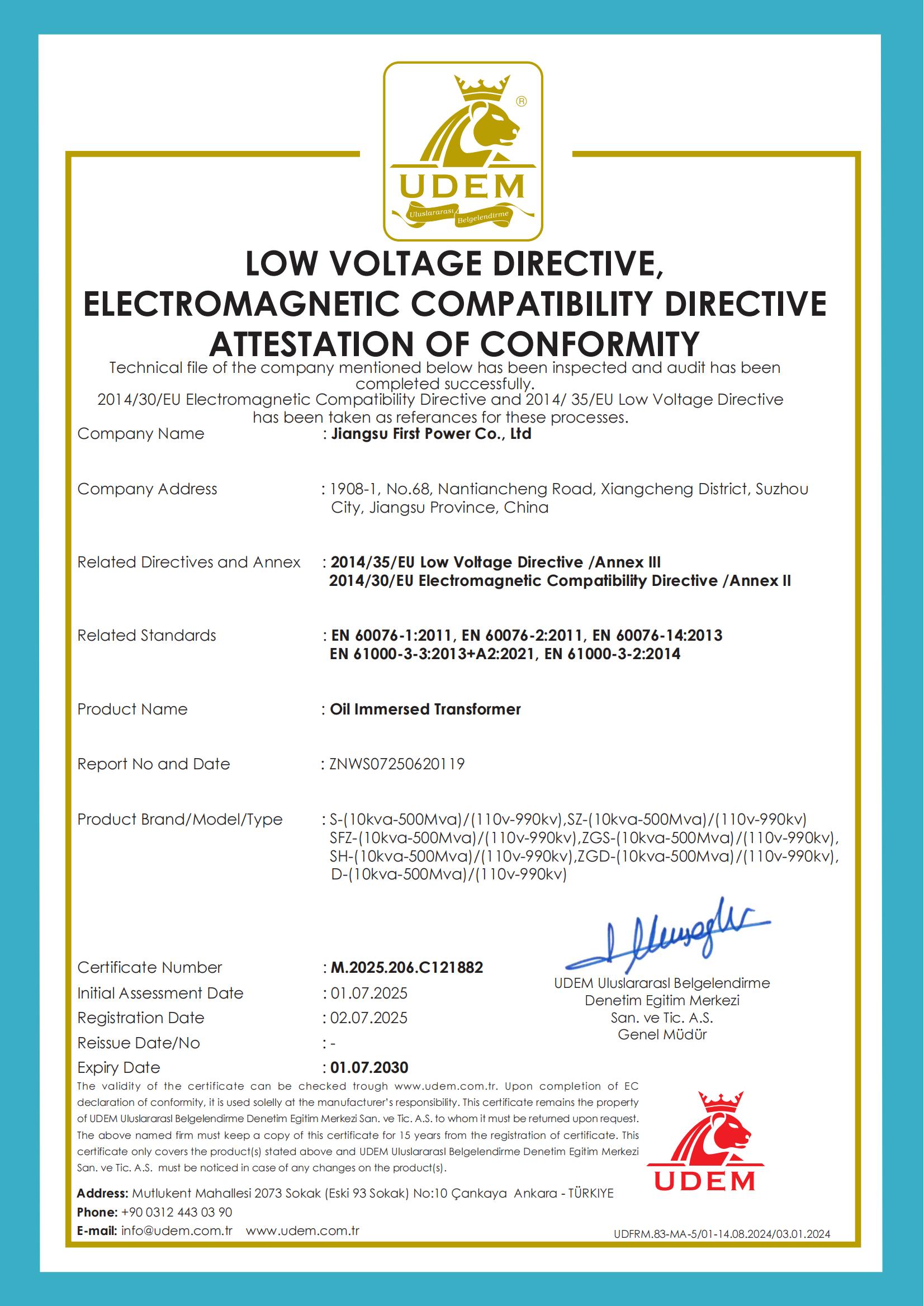
CE · Oil Immersed
Certificate reference: No. M.2025.206.C121882 · validity 2025–2030. Verify scope against the offered transformer model.
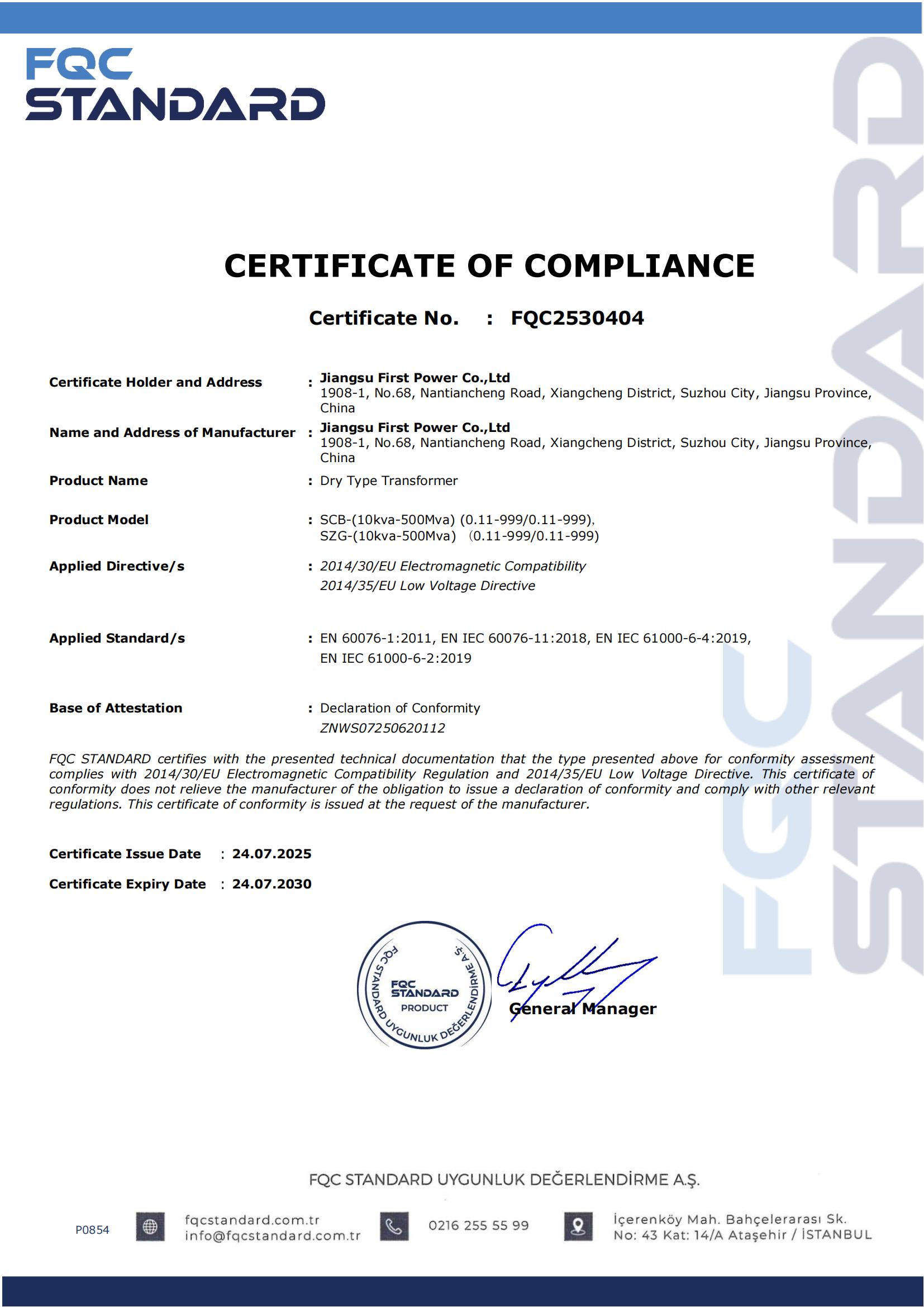
CE · Dry Type
Certificate reference: No. FQC2530404 · validity 2025–2030. Confirm the certificate covers the dry-type rating and enclosure offered.
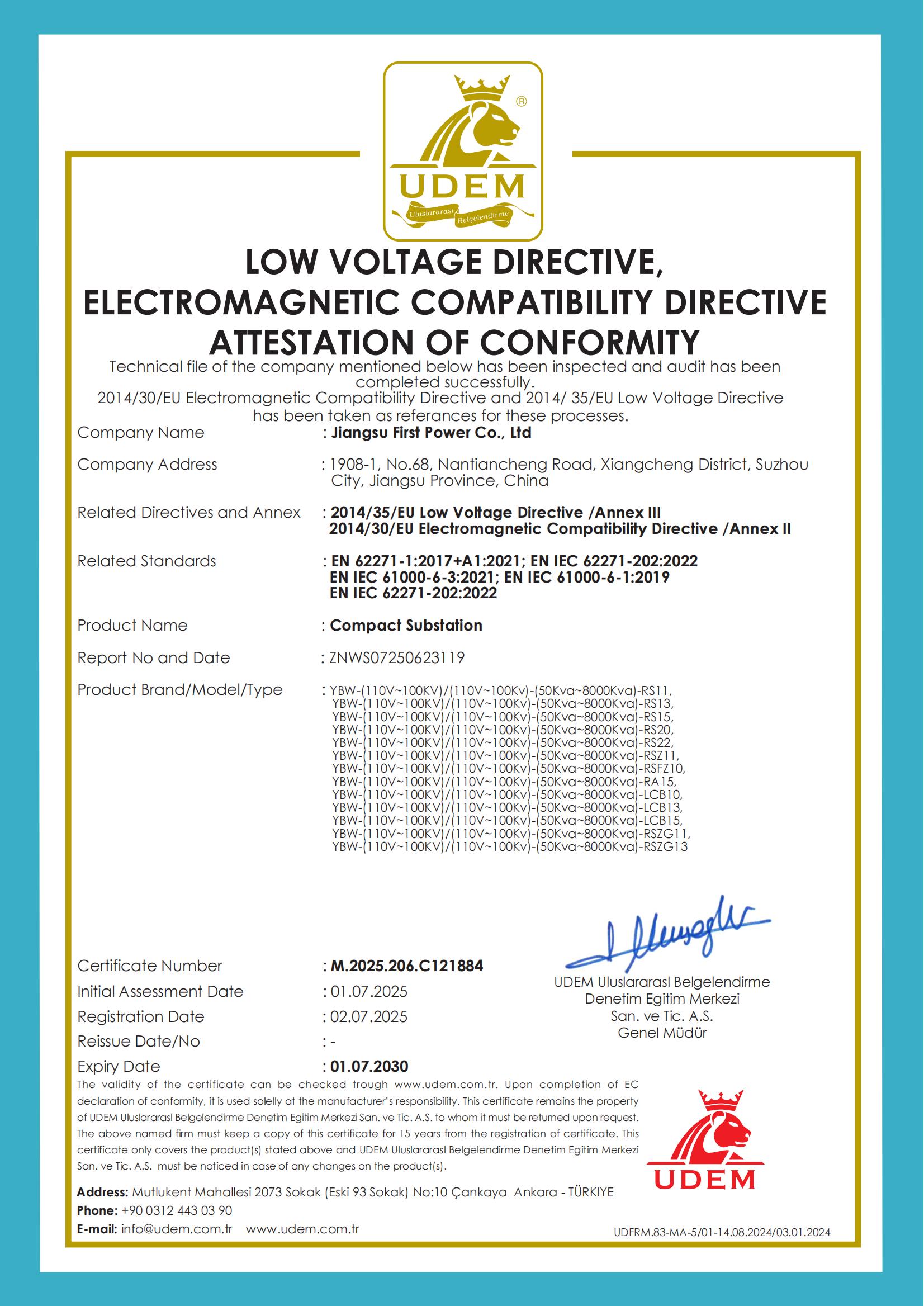
CE · Compact Substation
Certificate reference: No. M.2025.206.C121884 · validity 2025–2030. Review MV switchgear, transformer and LV interface scope.
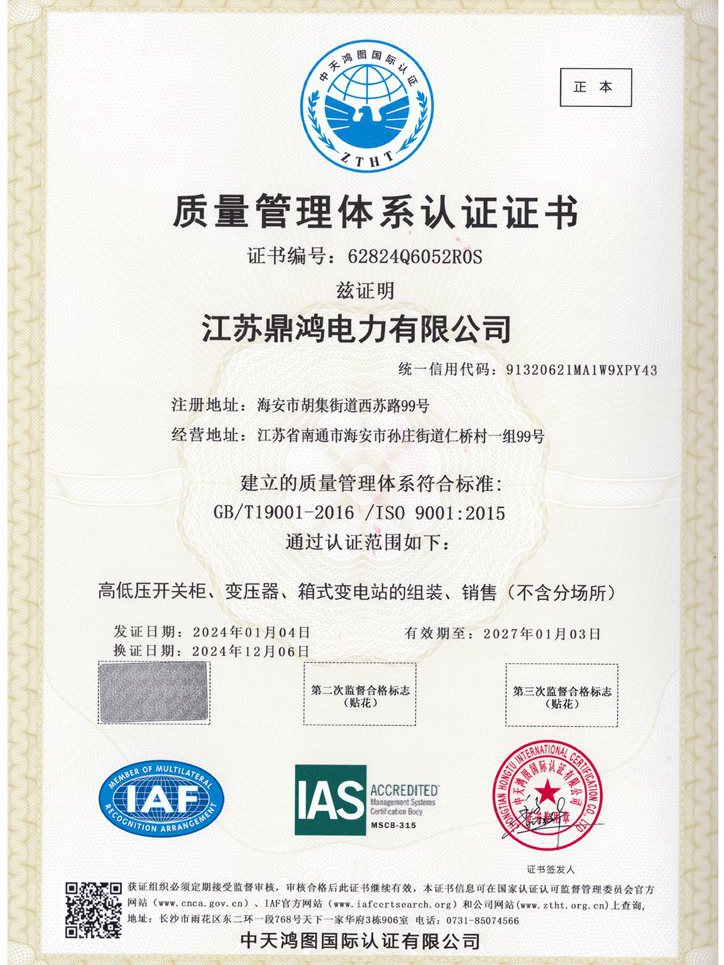
ISO 9001
Certificate reference: No. 62824Q6052R0S · validity 2024–2027. ISO 14001 and ISO 45001 references are also available for review.
Additional certificate references presented in the original company profile include CE power transformer No. 3N230310.JYTU038, ISO 14001 No. 62824E6053R0S and ISO 45001 No. 62824S6054R0S. Always verify the latest certificate status with the supplier and issuing body before contract award.
Matching Transformer Type to Project Risk
Product recommendations should start with the application, not the catalogue page. The right transformer type reduces civil works, shortens commissioning and simplifies local utility approval.
Utility Distribution
Prioritize guaranteed losses, routine test evidence, vector group, tap range and standardized protection interfaces. The S11 three-phase oil transformer and 100–630 kVA distribution paths are natural starting points.
Renewable Energy
Solar, wind and storage projects need compact layouts, fast interconnection and coordinated MV protection. Pad-mounted transformers and compact substations can reduce site labour and interface risk.
Industrial Power Supply
Industrial buyers should compare reliability, overload capability, ambient design and spare-parts availability. Step-up oil transformers and pad-mounted units are common fits for process and plant distribution.
Commercial & Data Centres
Space, noise, fire safety and maintenance access often dominate. Dry-type or pad-mounted designs should be selected after comparing load density, enclosure location and local code requirements.
Urban & Fire-Sensitive Sites
Hospitals, tunnels, basements and high-rise buildings usually benefit from dry-type transformers where oil-free operation, fire performance and indoor installation are priorities.
EPC & Export Projects
International projects need Incoterms clarity, sea-worthy packing, document control and local standard alignment. Buyers should verify whether the supplier can support both IEC and ANSI/IEEE project environments.
CE Certified High Voltage Transformer Supplier FAQ
Direct answers to the questions most frequently raised by procurement, engineering and compliance teams during supplier qualification.
What does “CE certified high voltage transformer” mean in practice?
In practice, it means the supplier should be able to show a certificate or declaration with a clear product scope, applicable directive and standard, model or rating range, manufacturer identity and validity period. For high-voltage equipment, buyers should not rely on a logo alone. Ask for the certificate number, the tested configuration and the relationship between the certificate and the exact transformer offered. If a project uses a special vector group, cooling method, enclosure or voltage class, confirm that the configuration is covered or that a project-specific compliance route has been agreed.
Which standards are commonly referenced for transformer design and testing?
IEC 60076 is widely referenced for power transformers, including rating, temperature rise, dielectric tests and loss measurement. For North American projects, ANSI/IEEE C57.12 series standards are often specified for pad-mounted, pole-mounted and power transformer applications. The correct standard depends on destination market, utility practice, voltage class and project specification. A credible supplier should state the design standard, test standard and any customer-specific deviations in the technical offer, not only in the marketing brochure.
How can I verify a supplier’s CE certificate before placing an order?
Request a clear copy of the certificate and check the certificate holder, manufacturing site, product description, model/range, standards, issuing body, issue date and expiry date. Ask the supplier to explain which offered model is covered and whether any subcomponents or accessories are excluded. For projects with high compliance risk, verify the certificate directly with the issuing body and request a model-linked routine test report. Also compare the certificate scope with the nameplate data and GA drawing. This prevents a common problem where a supplier has a valid certificate for one product family but the quotation includes a different design.
What factory tests are normally performed before shipment?
Routine tests typically include winding resistance, voltage ratio and vector group, impedance and load loss, no-load loss and current, applied voltage and induced voltage withstand tests. Liquid-filled transformers also require oil dielectric strength testing and related oil checks. Depending on the specification, buyers may also request temperature-rise type test evidence, short-circuit type test evidence, partial discharge measurement, noise measurement and third-party witness inspection. Every report should be linked to the serial number and date of the actual unit, and should be included in the shipment documentation package.
Can transformers be customized for 50/60 Hz, voltage class, vector group or enclosure?
Yes, customization is a normal part of export transformer procurement. Ratings, primary and secondary voltage, frequency, vector group, impedance, tap range, cooling method, insulating fluid, bushing configuration, enclosure color, cable arrangement and nameplate language can be adapted to the project specification. The key is to document the agreed requirements in the technical offer and drawing approval before production. Buyers should also confirm the applicable standard, altitude, ambient temperature, seismic requirement and any utility-specific interface details.
What trade terms and payment methods are usually available?
Export suppliers commonly work with FOB, CFR, CIF, EXW, FCA, CIP, CPT and DDP terms. Payment methods may include T/T, L/C, D/P and D/A, subject to contract and country risk review. The original Wisegj company profile lists multiple Incoterms and payment options, plus currencies such as USD, EUR, GBP, CAD and AUD. The correct choice depends on freight control, customs experience, financing cost and project cash-flow requirements. Buyers should make the Incoterm, currency, payment milestone and document release conditions explicit in the purchase order.
What information should be included in an RFQ for a faster quotation?
Provide rated power in kVA or MVA, primary and secondary voltage, frequency, vector group, impedance, tap changer type and range, cooling method, insulating fluid or dry-type class, applicable standard, site altitude, ambient temperature, installation location, enclosure requirements and target delivery schedule. Include single-line diagrams, utility specifications and any loss limits or efficiency requirements. If available, send the nameplate standard, protection interface and cable arrangement. This allows the supplier’s engineers to return a compliant design with guaranteed losses instead of a generic price sheet.
Request a CE Compliance Review and Technical Offer
Share your datasheet, tender specification or single-line diagram. The Wisegj engineering and export team can review transformer type, voltage class, frequency, losses, enclosure, test documentation and delivery terms, then respond with a project-specific technical path instead of a generic catalogue reply.
Inquire Now For project files and drawings, include the destination country, applicable standard, voltage ratio and required delivery timeline so the review can start without clarification delays.